Is it a song, a time machine, or a cultural phenomenon?
When No na dropped “Honk!” on July 31, 2026, it turned out to be all three. Honk! by No na recently went viral.
Its music video shows upbeat dances with a mix of Indonesia’s unique culture visually and through its catchy lyrics.
The MV also revived trends that used to be viral across the globe.
Let’s dive into the wondrous time capsule and discover what it truly hides.
Breaking Down No Na’s “Honk”: Story Behind the Catchy Lines
1. “Om Telolet Om”
“Om Telolet Om” kicks in right at 0:24. It is delivered by Rich Brian, a world-renowned Indonesian rapper signed under the 88rising label. Have you ever caught yourself listening to the phrase “Om Telolet Om” backed by the distinct sound of a bus horn? Let’s break it down: “Om Telolet Om” or “Uncle, honk your horn, uncle!”
(Video: No Na – Honk! Music Video, Youtube)
“Om Telolet Om” was a phenomenon that gained popularity and became a trend in Indonesia in 2016. This trend began with children along the Pantura highway (particularly in the Jepara area and its surroundings) who would wait for buses to pass by while shouting and holding up signs that read “Om Telolet Om.” They would ask the drivers to sound their modified horns, which produced a unique “telolet” rhythm, and then record it.
This phenomenon also went viral globally in late 2016 after several world-renowned DJs, such as DJ Snake, Marshmello, and Zedd, tweeted the phrase on social media and even added the famous telolet sound into their EDM tracks.
There is a subculture in Indonesia called “Bus Mania” for many intercity bus enthusiasts who appreciate modified long-distance buses, ranging from liveries and bus interiors to their signature horns.
Many bus drivers began installing multi-tone horns that play rhythmic and catchy melodies that bring joy to the people, mostly children at the time, which the community followed and started the trend.
This shows that even something silly can have a big influence, locally or internationally. Moments like this show how local trends carry unique cultural context, making them tricky to translate without losing their original charm.
2. “Get on The Angkot”
The line “Get on The Angkot” is not sung just once, it pops up repeatedly at 0:30, 0:38, 0:46, and throughout the song. With its infectious beat and driving rhythm, this part gets listeners instantly grooving along.
(Video: No Na – Honk! Music Video, Youtube)
But what is the meaning of “Angkot”?
“Angkot” is short for “Angkutan Kota” (City Transport or City Transportation). It is a small minivan that usually seats 9 to 15 people on the long benches facing each other and is used for short-distance travel within cities.
The Angkot follows a specific route depending on its color or route number and can drop off or pick up passengers when instructed. Many people in Indonesia use this as it is the cheapest transportation besides taxis and motorbike taxis, or called “Ojek”.
It started back in WWII and the early Indonesian Independence era, and its predecessor was called Oplet, which is a German car brand called Opel. It became so iconic as a classic blue retro minivan that it’s featured in an Indonesian TV series called Si Doel Anak Sekolahan, which uses the Oplet-type Morris Minor 1000.
From this lyric alone, it shows that Indonesia has a unique history in the simplest things. Here is a fun detail you might have missed: at the 0:13 mark in the music video, Christy taps on the angkot door/body twice.
In Indonesia, that double knock is a universal signal to the driver that everyone is settled in and ready to roll.
3. “Kakak-Adek Centil like me”
“Kakak, Adek, Centil Like Me” stands out as one of the iconic lyric moments in the song, featured between 1:07 and 01:09 in the music video. At 01:07, a quick split-second frame captures Christy striking a “centil” pose on top of a Pit Mini, a popular term in Javanese society for a 24-inch girl’s bicycle.
Right after, the camera shifts toward Shazfa, who is also posing “centil” on a push bike. The brief scene features the line “Kakak-Adek.”
(Video: No Na – Honk! Music Video, Youtube)
But what is the meaning of “Kakak-Adek”? In a subtle, visual way, the music video director signals to global audiences that Christy embodies the “kakak,” an Indonesian term used to address an older sibling.
Meanwhile, Shazfa takes on the role of the “Adek,” a casual, colloquial spelling of “Adik,” which refers to a younger sibling. This visual storytelling reflects the fact that Christy is the oldest member of the group, while Shazfa is the youngest member in No Na.
Around the 01:09 mark, the music video brings them together as Christy and Shazfa dance playfully in a “centil” style to the lyrics “Centil Like Me.” Do you know what the word “Centil” actually means?
So, back then in Indonesia, “Centil” referred to a girl who is overly coy, flirtatious, or seeking attention. But in this era, modern Indonesian youth, especially women, have reclaimed the word “centil” into a more positive meaning; it serves as a positive marker of playfulness, fashion-forward confidence, and self-love.
Acting “centil” in a modern context no longer implies flirtatiousness toward others; rather, it reflects an unwavering confidence in expressing ourselves. Put together, “Kakak-Adek Centil Like Me”, the line becomes a cute yet powerful chant celebrating sisterhood, confidence, and owning your style.
Looking at the semantic reclamation of the word “centil” and the cultural weight behind “kakak-adek”, it becomes clear why localizing pop culture goes far beyond word-for-word substitution.
When lyrics like these are processed through literal or automatic translation, the emotional resonance and modern social context behind the words are often lost entirely.
4. “Sabang sampai Merauke”
The line “Sabang sampai Merauke” comes in at the 1:42 mark, and it is sung quite frequently toward the end of the song.
(Video: No Na – Honk! Music Video, Youtube)
Before we dive into what this line actually means, let me inform you that Indonesia is the world’s largest archipelagic state, covering a total area of about 1.9 million to 7.8 million square kilometers, including its oceans and Exclusive Economic Zone (EEZ).
This status is officially recognized under the 1982 United Nations Convention on the Law of the Sea (UNCLOS). On top of that, Indonesia ranks as the country with the 6th most islands in the world, boasting a total of 17,480 islands.
Now, let’s get into the main topic: “Sabang” and “Merauke” are the two furthest boundary cities of Indonesia. Sabang is the westernmost city of Indonesia, situated on Weh Island in the west of Aceh Province. Merauke lies in the southeastern corner of the country, located in South Papua Province.
The word “sampai” means “to,” so essentially “Sabang sampai Merauke” means “From Sabang to Merauke.” It is widely used as a popular geographic phrase to describe the entire span of the nation from the far west all the way to the southeastern tip of Indonesia.
Spot the Hype: Every Viral Trend Reborn in “HONK”!
1. Citayem Fashion Week
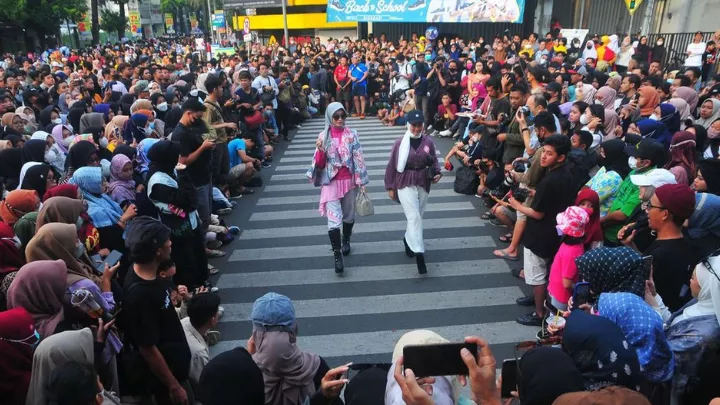
(Image: Catwalk di Citayam Fashion Week – ANTARA FOTO/YUSUF NUGROHO)
There is an aesthetic scene at the 0:55 mark, where one of NoNa’s members, Baila, walks across a zebra crossing like a runway model against a backdrop of street vendors and skyscrapers.
This visual is a direct homage to the Citayam Fashion Week (CFW) phenomenon that took Jakarta by storm in 2022.
At that time, thousands of teenagers from the suburbs used the zebra crossing in Dukuh Atas as their “Third Space”. They transformed the exclusive street into a street fashion runway that was open to everyone.
This scene in the “HONK” music video serves as a clever metaphor, proving that fashion, art, and freedom of expression are everyone’s right, regardless of economic class.
2. The convex mirror trend in nona’s MV
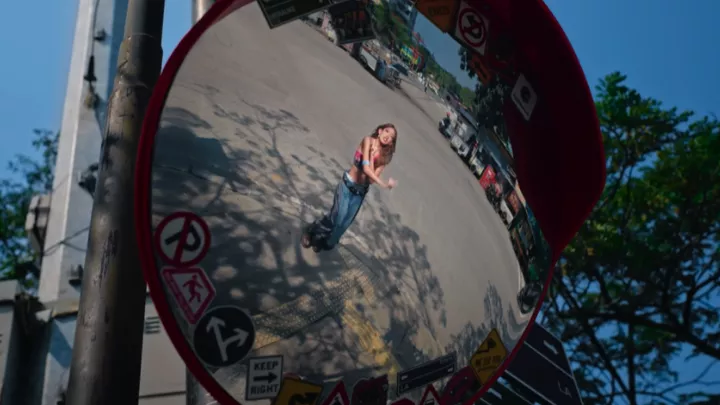
(Image: No Na – Honk! Music Video, Youtube)
A convex mirror is a mirror with a curved surface that bends outward. It is commonly found on roads, in parking areas, and at blind corners to provide a wider field of view.
In many other countries, convex mirrors are generally associated with their practical purpose. However, in Indonesia, their use has expanded beyond safety. It became a trendy spot for mirror selfies.
Young Indonesians often take selfies in these mirrors because their curved surface creates a unique, distorted reflection that makes the photos look cute and different from a regular mirror selfie.
To make them even more eye-catching, some convex mirrors are decorated with cute stickers, colorful designs, or playful decorations, making the mirror itself part of the photo.
Today, you can find these mirrors not only on roads, but also in public places such as cafés, photo studios, and even along streets during Car Free Day (CFD), where people use them as unique photo spots.
And here’s the interesting part in Indonesia, convex mirrors have even become a business opportunity. Some people have started placing convex mirrors in popular spots and charging people to take photos with them.
3. The # KikiChallenge Meets ‘Es Goyang’
(Video: No Na – Honk! Music Video)
Have you ever heard of the #KikiChallenge that went extremely viral globally in 2018? This challenge, which involved dancing alongside a slowly moving car with an open door, once became a global epidemic.
The dangerous stunt caused numerous accidents until the Indonesian National Police officially banned it for violating traffic laws.
NoNa brilliantly recreates this trend in their “HONK” MV. The shot is taken from a point of view inside the car cabin, showing the dance routine happening outside through a wide-open door.
However, this scene was strictly filmed in a highly safe and controlled environment. As a result, they successfully brought back the nostalgic euphoria of 2018 internet culture without promoting the actual danger.
To emphasize the dance challenge, if you look closely at the scene around 0:15 while Shazfa is dancing, there is an “es goyang” cart. Es goyang is a traditional Indonesian frozen treat associated with Bandung and reached its peak of popularity in Jakarta during the 80s and 90s.
It is a traditional Indonesian ice cream made from a mixture of coconut milk, sugar, and hunkue flour. The name “es goyang,” which can roughly be translated as “shaking ice” or “dancing ice”, comes from the way it is made. The ice cream cart is shaken for approximately five minutes to help the mixture freeze properly.
This small detail is one of the creative touches that makes NoNa’s “HONK” MV particularly worth appreciating. The appearance of the es goyang cart is not merely a nostalgic prop placed in the background; it also serves as a clever representation of the members dancing beside it.
The word “goyang,” meaning “to shake” or “to dance,” cleverly echoes the main action taking place in the video.
It is a subtle yet thoughtful detail that connects a nostalgic Indonesian street snack with NoNa’s choreography, adding another layer of local culture to the MV.
The Culture that Elevates Your Business
Honk! is more than just a fun and energetic song. Underneath the catchy lyrics and colorful visuals, there is a collection of Indonesian cultural references, from the Om Telolet Om to the Citayam Fashion Week and the nostalgic es goyang treat.
By bringing the familiar culture of Indonesia, NoNa’s song makes something that’s both nostalgic and new, unique yet familiar.
One or two references may seem ridiculous at first or even forgotten; yet NoNa is still able to preserve the fascinating peculiarity in an authentic style.
Indonesia is a vast archipelago rich in cultures. To effectively communicate your business in Indonesia, meticulous localization involving pop culture is an essential consideration.
Unlock deeper engagement in Indonesia with pop-culture-aware localization. Get in touch with PEMAD to elevate your content.